Shops and loadouts
What players start with, and what they can buy.
Loadouts
Loadouts decides what a player starts holding and what they can pick at character creation. It's hidden when Setup says players choose neither items nor abilities.
Vendors
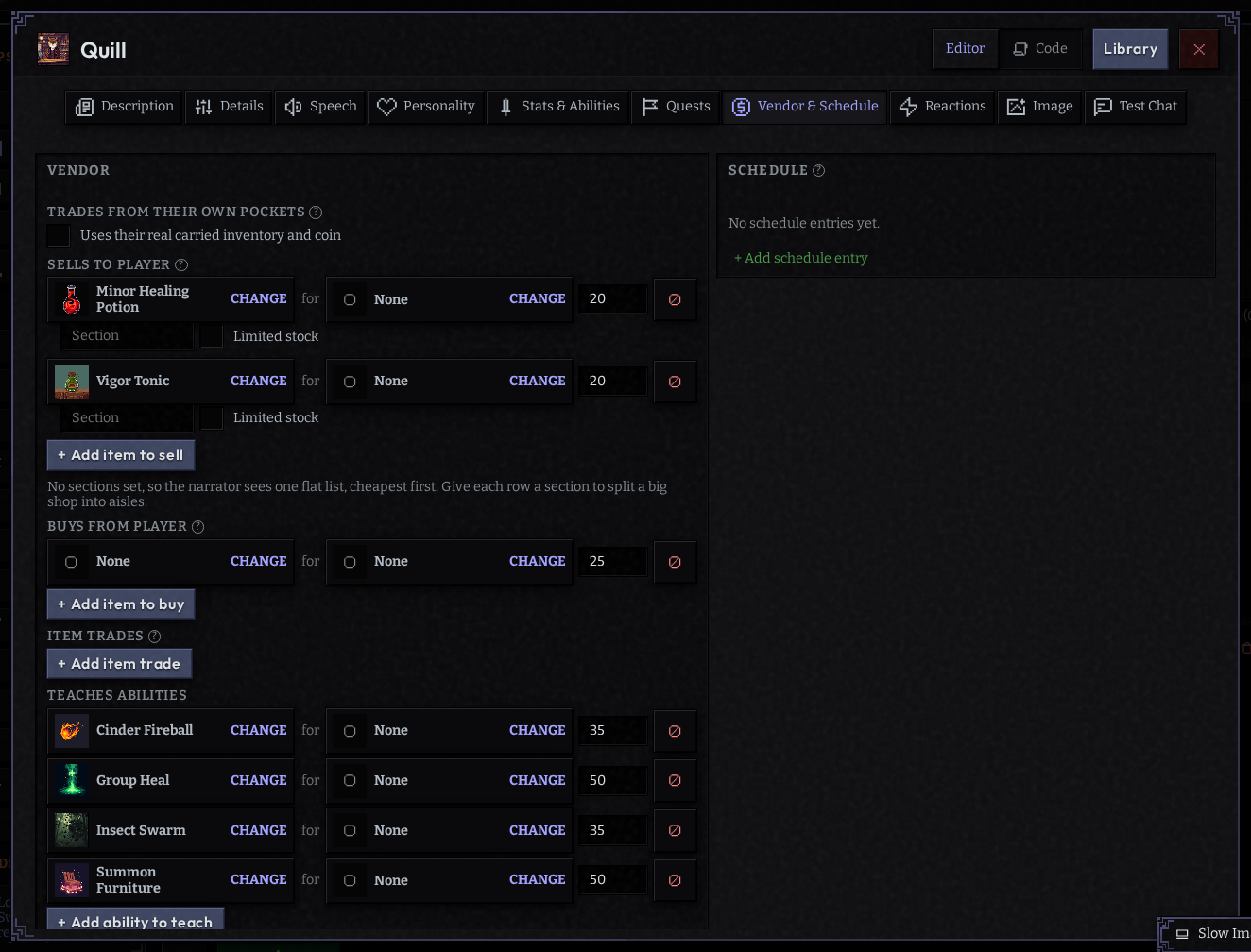
Any character can sell things. The Vendor tab sets what they stock, what they pay and what they won't touch. A vendor is still a character, with a schedule, memories and opinions. The smith who won't sell you a blade because of what you did last week is one NPC, not a special case.
Running out
By default a shop never runs out of stock or money. That's right for most shops. Nobody wants to count a general store's candles.
When scarcity is the point, switch it on:
| Switch | Where | Does |
|---|---|---|
| Limited stock | per item | A real count. Drops as players buy; the vendor refuses at zero. |
| Restocks | next to limited stock | Refills a few every so many turns, up to a cap. |
| Vendor's money | the vendor's till | What they can pay out. Drain it and they stop buying. |
Stock and money run on the world's clock, not the player's. Leave town for thirty turns and the shelves are full when you get back. Leaving doesn't pause the economy.
The narrator is told what's sold out before it writes the scene, so an empty shelf becomes dialogue ("I'm out of credits right now") instead of a sale that fails silently.
Trading from their own pockets
Trades from their own pockets makes the character's carried items the stock and their coin the till. One inventory: what they sell is what a pickpocket could lift and what their corpse would drop. Sell them something and you can buy it back, or steal it.
Use it for a person (a pedlar, a fence, a smuggler), not a premises. Their starting items are their stock; the counters above are ignored.
Details: Vendor stock and money.
Services
A vendor can also sell work: a blessing, a repair, a curse on a rival. Add it under Services on the Vendor tab with a price and the steps it runs. Players can buy one for themselves or for someone else in the scene. Details: Vendor services.
Big shops
Give each sell row a Section on the Vendor tab, in this shop's own words: Blades, Tonics, Contraband. Two vendors can shelve the same item differently. Headings only appear when they actually group something. Rows with no section go under Other. The field suggests the sections this vendor already uses, so spellings stay consistent.
Currency
Named in Setup. Call it Credits, Marks or Favors and everything follows.
Making shops matter
- Stock what the world would have. A fishing village doesn't sell plate armor.
- One great item beats a shop full of tiers. Give it a stock of one and no restock, and it's gone for good once someone buys it.
- An emptied shop tells a story. A smith with no iron left says something about the war without a word of dialogue.
- Vendors keep hours. A shop shut at night is a reason to plan the day.