Locations and the map
Places, how they connect, and what makes one feel different from the next.
A location is somewhere the party can be. Characters stand in them, items lie in them, creatures wait in them.
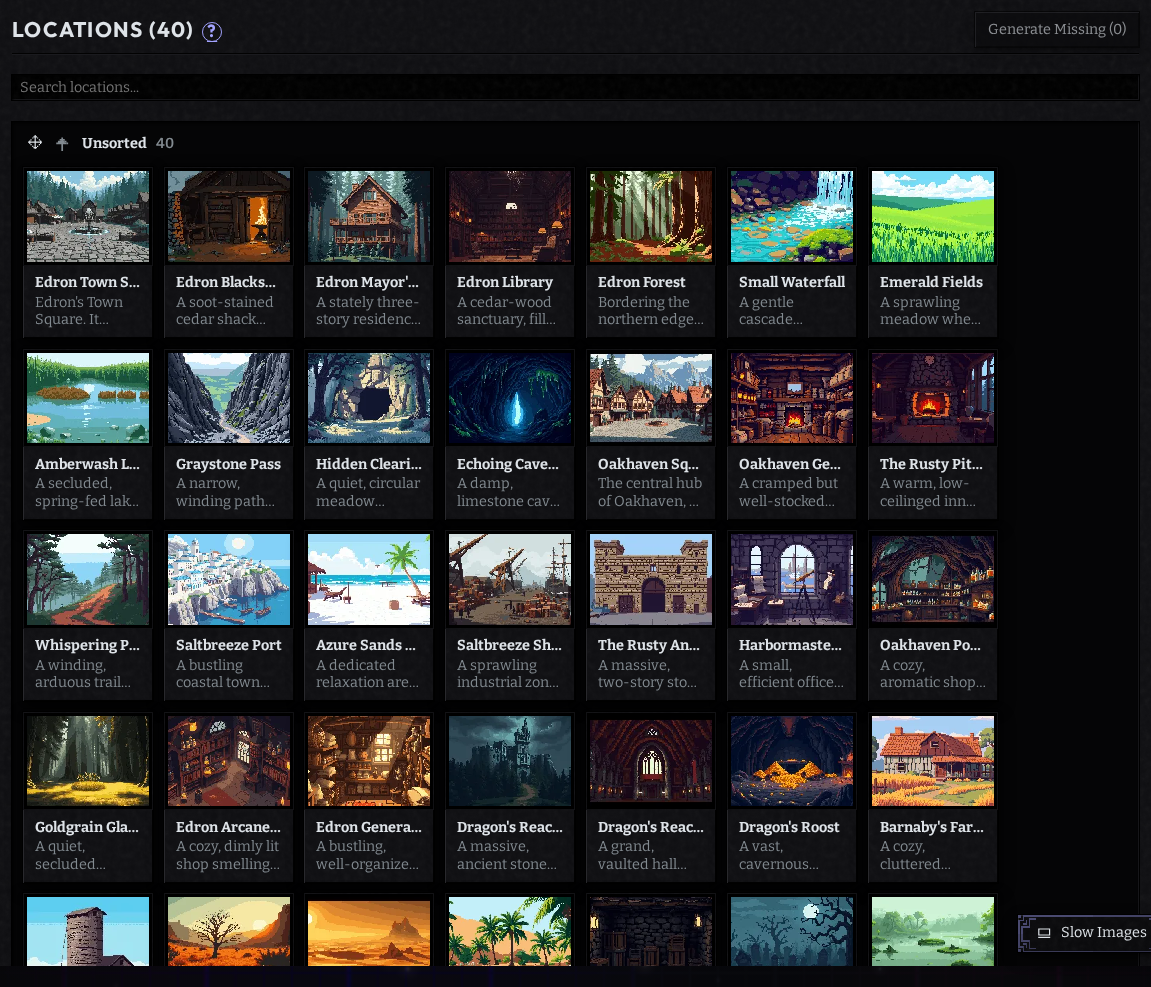
What a location has
- Name and description. The narrator reads the description to set the scene. Write atmosphere (light, sound, smell, what's wrong here), not a list of contents. Items and creatures are tracked separately and get mentioned on their own.
- Lore. History, legends and local talk about the place: who built it, what happened here, what people say about it. The narrator knows it the whole time the party is here, and players read it on the location's card. Background the whole world shares belongs in Lore instead.
- Items and creatures that start here.
- Entry requirements. An item needed to get in: a key, a permit, a lantern. Leave empty for an open place.
- Ambient sound that plays while the party is here. See Sound and images.
Making places differ
- Conditional backdrops. One location can look different depending on a world flag: the harbor before and after the storm, without being two locations.
- Indoor or outdoor. Tag a place indoor and the weather stays outside: no rain on screen, only its sound through the walls. A cave isn't rained on.
- Its own clock. A moon or another plane can have its own day length and sunrise.
The tabs
| Tab | What it does |
|---|---|
| Description | Name, what the narrator sees here, its lore, and whether it is indoors or outdoors. |
| Contents | Items and creatures found here: whether each starts here, whether it is hidden, how many can be here at once, and how often they come back. |
| Entry | What it takes to get in. A soft gate is a hint the narrator enforces in the story; a hard gate is an item the engine requires. |
| Events | Things that happen here by themselves. See World events. |
| Clock | Its own day length and sunrise, for a moon or another plane. |
| Ambient | Background sound and drifting particles (snow, embers, dust). |
| Image | The backdrop, plus conditional backdrops that swap on a world flag or time of day. |
Hidden things
Tick Hidden on an item or creature in Contents and it's there, but unseen. The party can't see it, name it, pick it up, talk to it or fight it. It doesn't show on screen, and the narrator doesn't know it's there.
- A good search finds it, if it looks in the right place. An item's Placement says where it lies ("taped beneath the heaviest desk"). A player who searches there and succeeds finds it; one who searches the bookshelf doesn't. A failed search finds nothing, and they can try again. A thing with no placement is found by any good search of the place.
- A clue gives it away. An item's Clue while hidden (on its Description tab) is what the scene shows while it stays hidden: "a strip of tape curls from under the desk". A hidden creature has its own clue beside its Hidden box. Players who read the room know to search.
- A rule can reveal it too: a lever, a spell, a world event. See Revealing and hiding.
NPCs can start hidden as well: tick Starts hidden under their home location.
A hidden creature sits out every fight until it's found, so an ambush is a reveal followed by an attack.
Sneaking
The party can hide too. A player who creeps, hides or slips past someone rolls for it, and on a pass the whole party is unseen: nobody knows they're there, wherever they walk. Nobody greets them, follows them, ambushes them or starts a fight with them, so it's the way past a guard, and the moment to lift something off a belt. The scene shows Unseen while it lasts.
It ends when they give themselves away: attacking, speaking to someone, trading, handing something over, or anything else done in the open, like knocking over a lamp. A failed roll to stay hidden gets them seen, and so does a fight breaking out. Walking on quietly never does.
Nothing needs setting up. A guard who kills intruders on sight still does, to anyone they can see. For one player vanishing on their own, a potion or a cloak, use an Invisible effect instead.
The map
Connections are how the party moves: a location with no connections can't be reached. See The map.
Tips
- Put distance between safe and dangerous places. Travel means something only if the road costs something.
- Give each location a job: a place to rest, trade, learn something, or get hurt. Two locations with the same job should probably be one.
- Dead ends are fine if something is there. A dead end with nothing in it is a wasted trip.