Items and creatures
Things to carry, things to fight, effects, abilities, and loot.
Items
An item is anything that can be carried, worn, eaten or used.
- Description: what the narrator says about it. Concrete and specific: what it looks like and why it belongs in this world.
- Stats and effects: what it does when worn or consumed.
- Equip slot: where it's worn. No slot, no wearing.
- Equip requirements: a minimum stat to wear it, like a greatsword that wants 14 strength. Only matters if the item has a slot.
- Category: free text like reagents or salvage. A hint for the item's art. Shop sections are set per vendor, not here.
What happens when it's used
Simple uses need no code: heal some, apply an effect, get used up. A healing draught is three clicks. For "only at night" or "only if the drinker is poisoned", add a condition.
Things that act on their own
An on turn rule runs every turn with nobody using the item: while someone carries it, or
while it lies in the room the party is in. Lying in a room it acts as itself, so enemies is
everyone there. A fire burns whoever stands near it; a trap snaps at whoever walks in.
Give a spawned item a lifetime with $.spawnItem({ item: 'House Fire', minutes: 90 }) and it
is unmade when the time runs out, running its on destroyed rule, whether or not anyone is
watching. Bodies rot the same way: the Bodies plugin gives each one a lifetime from its
Minutes before a body rots away dial. Give an item health and players can fight it down
sooner: douse the fire, smash the trap.
Variables: what an item remembers
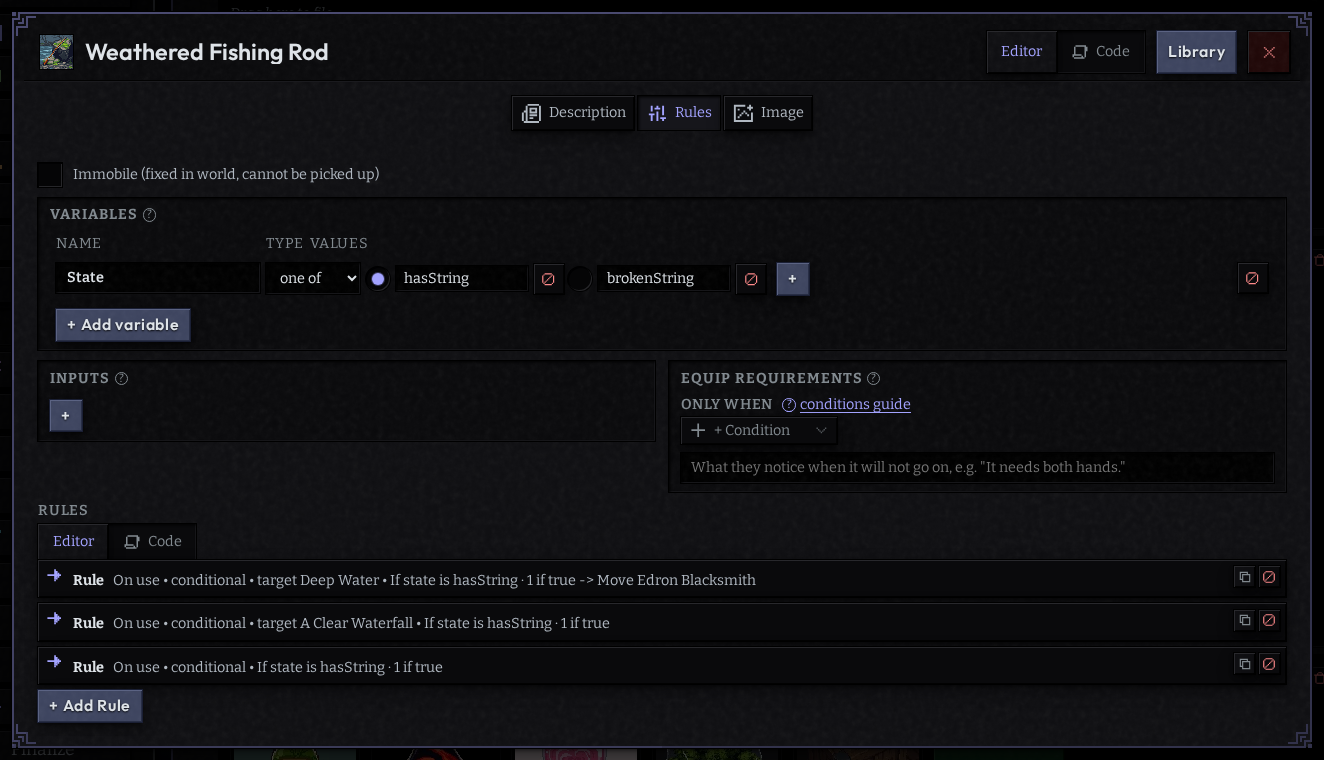
A variable is something an item keeps between turns: a lamp that's lit, a gun's ammo, a door that's been forced. Add them on the item's Rules tab. Most items need none.
| Type | Holds | Example |
|---|---|---|
| number | a number | charges, ammo |
| one of… | one word from a list you write | state: locked or open |
| text | any text | an inscription someone carved |
Use one of… whenever a rule will check the value. The list means a rule can't check for a value the item can never have. Use text only for things no rule compares, since a typo there silently never matches.
state is just the variable most items want first. An item can have several.
Rules read and write them like this:
$.item.state === 'lit'                           // read
$.item.fields.ammo                               // read a number
$.setField({ field: 'state', to: 'lit' })        // write a word
$.adjustField({ field: 'ammo', by: -1 })         // move a number
$.setField({ field: 'state', to: 'open', onItem: true })  // on the item it was used ON
Plugin values on the Description tab are different: numbers a plugin puts on every item, like weight. See Fields.
Equip requirements
Who the item will go on, and what they notice when it won't. A greatsword that wants 14 strength, a ring only an elf can wear. The refusal is read aloud, so write it in the world and without numbers: "The blade drags at your wrists; you can barely lift it.", not "Requires STR 14". Only matters if the item has an equip slot.
Ways to use it
Every usable item lists the ways it's used, one verb each: bread is eat, a potion drink, a
scroll read, a wand cast and charge, a terminal help, run and exit. Each use rule picks
the way it answers under Way of use, so one item behaves differently per verb, and a player
who only sniffs the bread or waves the wand around uses nothing. A rule left on Any way fires
however the item is used, and is also the only kind that fires when nothing says how.
Creatures
Things that fight. Only shown when combat is on in Setup.
- Stats set how dangerous they are.
- Loadouts give them gear. A bandit with a sword hits differently from one without.
- Loot tables decide drops, each with a chance. Rare means rare.
- Where they spawn matters. A creature should live where it makes sense: wolves in the woods, drowned things in the flooded shed.
- Protections set what nothing can do to them. See Protections.
Effects
A status that lands on someone and wears off: poisoned, blessed, burning. Effects are their own step because many things apply them: items, attacks, locations, rules. Define it once and it behaves the same everywhere.
Durations come in three kinds, picked under Duration type on the Mechanics tab. Turns count down once per turn, in a fight or out of one, which suits a stagger or a stun. Real duration is minutes of world time, which is what a disease or a day-long blessing needs. Until removed never wears off by itself: it lasts until a cure, a dispel, or taking off the item that granted it ends it. Pick turns for a plague and it cures itself in a few steps.
A step can also override the duration for one application:
$.applyEffect({ effect: "Burning", turns: 2 }), $.applyEffect({ effect: "Cursed", permanent: true })
or minutes: 60.
Tick Invisible and nobody can see whoever carries it. An invisible NPC or creature drops out of the scene, though not out of a fight it's already in. An invisible player is left alone by everyone who can't see them: no greeting, no ambush, no fight started with them, and in a fight foes go for someone they can see first. It lasts as long as the effect does, so to end it when they strike, give it the reaction below.
Reactions: what an effect does while someone carries it
An effect can react to what happens to whoever carries it, with the same hooks a character or creature has. They run only while the effect is on someone, and steps land on the carrier. Invisibility that ends the moment its carrier swings:
if ($.event.attacking) {
  $.removeEffect({ effect: "Invisible" })
}
That's an onAttack reaction on the Invisible effect. A ward that steadies its carrier every
time they're swung at is the same shape the other way round: $.event.attacking is false.
Particles: what an effect gives off
The Particles tab gives an effect something to show on whoever carries it: flames rising off a burning bandit, frost drifting down a chilled one, sparks crackling around someone charged. They start on the carrier's portrait and fade just past the card's edge, for as long as the effect lasts. Pick a preset, then tune color, direction and speed against the preview; it runs the same particles the table does. Locations use the same controls on their Ambient tab.
Abilities
What a character can use beyond a plain attack: Fireball, Shield Bash. Only shown when abilities are on in Setup. An ability can cost a resource, have a cooldown, and have a condition for when it's usable.
Where the numbers come from
Damage, armor and spread are formulas. If you want armor to matter more, change the formula instead of inflating every stat. As shipped, a blow works like this:
| Part | As shipped |
|---|---|
| Hit points | 10 + (might + resolve × 3) / 5, plus one per level: about 18 for an average character |
| To hit | a d20 plus half of accuracy above 10, against half the target's evasion: most blows land |
| Weapon | its damageDice plus statMods.damage; bare hands roll 1d4 |
| Stat term | a tenth of might in melee, a tenth of agility at range: +1 for an average 10 |
| Armor | every point of defense comes straight off every blow, and a blow never drops below 1 |
Armor is flat, so it stacks harder than it looks. A sword averages about 5 a hit. Three points of defense turn that into 2, and five points turn most blows into the minimum 1. Keep a full suit of heavy armor to single digits and give each piece 1 to 3, or creatures stop mattering long before the player reaches them.
Abilities and item rules roll their own dice and skip the weapon and stat terms, but armor still comes off what they deal.