Factions
Groups that want things, and how they feel about each other, written in plain words.
A faction is a group with an agenda: the Harbor Guild, the Drowned Choir, the Duke's men. Put characters and creatures in factions and the game uses those relations whenever members meet.
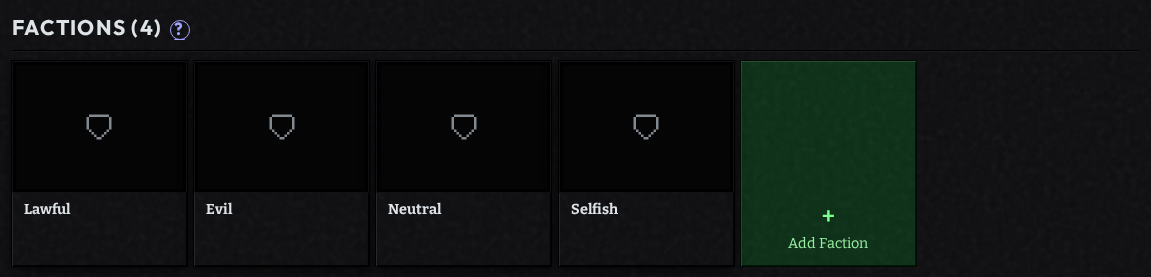
Identity
Name and Description. The description is who they are, what they want, and how a stranger would recognize one. Renaming a faction updates every member and every relation that names it, so rename freely.
Relations
A relation is one faction's stance toward another, written as prose, not picked from ally / enemy / neutral:
A trade truce both sides cheat. Guild captains will share a drink with a Choir member and report them to the harbormaster the same night.
That sentence carries things a label never could: they cooperate, they don't trust each other, and betrayal is expected. The narrator, off-screen fights between NPCs and gossip between them all read what you wrote and weigh it against everything else they know.
- Relations are one-sided. The Guild can resent the Choir while the Choir has written nothing back. A one-sided grudge is useful information.
- No relation means no opinion. Nothing is assumed; the game doesn't treat silence as "neutral".
- Only factions actually present in a scene reach the narrator, so a world with forty factions costs no more per turn than one with four.
Tips
- Write what members do about the relationship, not just how they feel. "Attack on sight" and "refuse to trade, but never draw steel inside the walls" play very differently.
- Two or three factions with sharp, conflicting wants beat ten polite ones.
- Do factions early. Characters, creatures and places hang off them.