Characters and NPCs
The tabs behind an NPC: memories, schedules, speech, quests and shops.
A name and a description are enough for the narrator to play someone. Everything else is optional and makes them act more like a person.
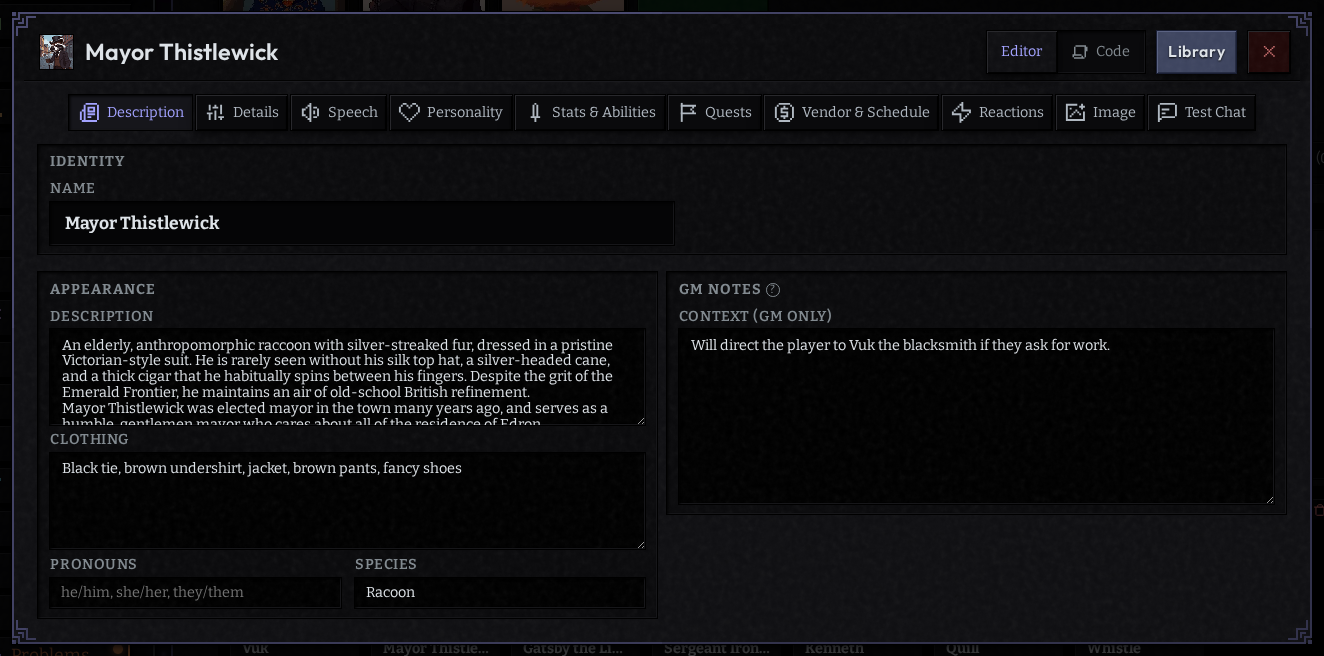
The tabs
Some tabs only appear when their system is on in Setup.
| Tab | What it does |
|---|---|
| Description | Name, who they are, and GM notes: backstory and secrets the narrator knows and players never see. The narrator plays them from the description. |
| Details | Where they belong and move: faction, home location, wander chance, a patrol route, places they will never go, and how they behave in a fight. Starts hidden keeps them unseen at home until they're found. |
| Speech | Voice and how they talk: rhythm, favorite phrases, tics. Only with voices on. See Voices. |
| Personality | Sayings & habits the narrator is nudged to use, each with a chance, and memories: moments they already remember, shown only when a scene touches them. Write them from the character's own view; when characters share a room they pass memories on in their own words. |
| Stats | Attributes, abilities, starting bonds toward the player from hostile (-5) to devoted (+5), whether they can be drawn into off-screen fights, and protections. |
| Quests | Jobs they hand out. See Quests. |
| Vendor & Schedule | Makes them a shop (see Shops), and timed objectives: where they go and what they do at set hours. |
| Reactions | What they do when the world does something to them: bleed when wounded, curse whoever robs them. See Hooks. |
| Image | Portrait, generated from a prompt you can edit. |
| Test Chat | Talk to them now, before you publish. |
Protections
What nothing in the game can do to someone, whoever asks: the narrator, a rule, or a player. Characters and creatures both have them, on the Stats tab.
| Protection | Means |
|---|---|
| Immovable | Never leaves the spot. Can't join the party, be sent away, summoned, teleported, or flee a fight. A stationary mobility only stops them wandering on their own; this stops everything. |
| Invulnerable | Takes no damage from anything. They can still be attacked, and still fight back. |
| Essential | Can't die. A killing blow leaves them beaten, out of the fight and barely standing, and they recover like anyone else. |
| Immune to | Effects that never land on them: a golem that can't be poisoned, a lich that can't be stunned. |
The player character
The same editor, pointed at the player, plus what players may choose at creation: stats, starting items, abilities. Setup decides how much choice they get.
Writing a good NPC
- Give them a want. A character with a goal makes scenes. One with only a description answers questions.
- Give them something they won't say. A secret or a lie is what makes a conversation worth having.
- Make the speech specific. "Speaks formally" is weak. "Answers every question with a question" is a person.
- Use the schedule. Being hard to find at the right time is a hook in itself.
- Test Chat every time. It's the fastest way to learn your "guarded" harbormaster reads as rude.