Quests without code
Multi-stage objectives built in the editor, judged by the story or by hard conditions.
A quest is a list of stages that complete in order.
Two kinds of stage
No condition: the story decides. The stage completes when the narrator judges it happened.
Convince the harbormaster to look the other way
There's no flag for "convinced". The narrator reads the scene and decides. This is what makes a quest feel like a story.
With a condition: instant and exact. Completes the moment the condition is true: has the relic, is at the lighthouse, the harbor is closed.
Most good quests mix both: exact gates where precision matters, judgment where it doesn't.
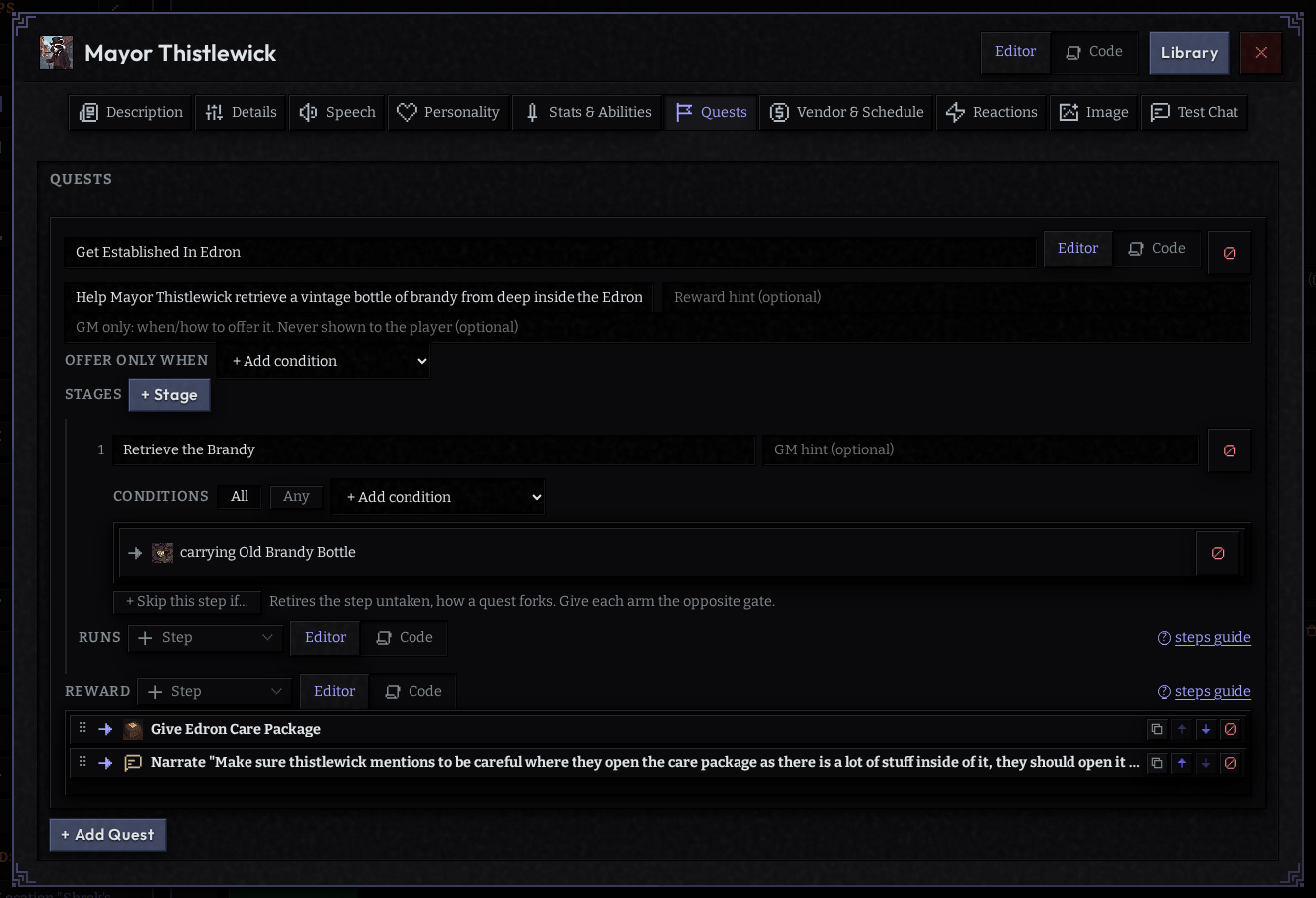
Rewards
Each stage can have rewards when it completes, and the quest has a final payoff. The reward text is something the quest-giver says out loud, so write it the way they'd say it.
Stages that remember
To connect a long quest, have an earlier stage set a world flag as a reward, and have later stages check it. World flags are visible everywhere, so a location's look, an NPC's mood and a later stage can all react to the same fact.
Forks: two ways through
Stages always run in order. To branch, put both paths in the list and let the one the player didn't take be skipped. Every stage has a Skip if condition for this.
- Record the choice. Click + This step is a choice… on the stage where the player decides,
name the key
path, and add two choices:mercywhen they spare him,bloodwhen they don't. The narrator records which one happened. A rule can record it too, by settingpath. - Escort him to the checkpoint. Skip if
pathisblood. - Report the body to the precinct. Skip if
pathismercy. - Collect your pay. No Skip if. Both paths meet here.
The skipped stage shows as failed, not done, so the journal never claims they did both.
Optional is not the same thing. Optional means "not needed to finish the quest". An optional stage that never gets done still blocks the quest. Use Skip if for forks, Optional for side errands.
If only the reward differs between paths, don't fork. Keep one list and let the rewards check the flag.
Example: the keeper's silence
- Talk to the keeper. No condition; the story decides.
- Find the logbook. Condition: has Logbook. Reward: set the world flag
KNOWS_ABOUT_TIDES. - Confront the harbormaster. No condition. The narrator knows the player has the logbook because stage 2 set a flag.
- Reward: experience and an item.
Making quests good
- Each stage should lead to the next. "Find the manifest" then "show it to the harbormaster" is a story. "Search the wreck" then "ask around" is two chores.
- Something should change at each stage: an NPC's attitude, a door, a line of narration.
- Use judged stages for the interesting parts. Talking someone round, earning trust, getting away. Use conditions for the bookkeeping.
When a quest needs arithmetic or reacts to something with no editor control, see Quests on the rules side.